
Written by: Angelina Zhou
Published: 23rd July 2026
In 2022-23, Australians recorded a net loss of $31.5 billion in gambling expenditure, the highest losses per capita in the world (Australian Institute of Health and Welfare, 2023). Accordingly, governments tightly regulate electronic gaming machines, sports betting and lotteries through age limits, advertising restrictions and consumer protections, including the 2024 ban on the use of credit cards for online gambling (E61.in, 2026).
Yet one of the fastest-growing consumer markets among young Australians, blind-box collectibles, shares many of the same economic characteristics while remaining almost entirely unregulated. Consumers repeatedly pay for uncertain outcomes, with little information about the probability of success, in pursuit of rare rewards.
Should economists treat these products differently simply because they contain a physical product?
Defining the Economic Problem
Australian law defines gambling as an activity involving three elements:
staking something of value;
an outcome determined partly by chance; and
the opportunity to win a prize.
Blind boxes do not neatly satisfy this legal definition as every purchase guarantees a physical product. The economic question, however, is whether they generate the same market failures that justify regulations surrounding gambling.
Gambling is economically distinguished from ordinary retail as it sells uncertainty as the product rather than resolving it. Retail purchases convert money into a known good, and standard consumer theory assumes that these purchases raise utility in a deterministic sense. Gambling, however, exchanges money for uncertain outcomes, making expected utility theory the appropriate framework to model these stochastic payoffs.
This distinction is compounded by information asymmetry, as operators possess near-perfect knowledge of the true odds and behavioural mechanisms that encourage continual betting, including near-misses and variable reinforcement, while consumers typically have a poor intuitive grasp of these probabilities.
Beyond private financial losses, gambling generates broader social costs through poorer mental health, reduced productivity, and family hardship. These costs are also borne partly by society, hence becoming negative externalities that provide a strong economic rationale for government and policy intervention (Hilbrecht et al. 2020; Latvala et al. 2019; Wardle et al. 2024).
Although blind boxes do not meet the legal definition, they exhibit many of these characteristics.
| Product | Certain outcome? | Unknown probability? | Repeat purchase incentive? | Regulated? |
|---|---|---|---|---|
| Ordinary toy | ✓ | ✕ | Low | No |
| Blind box | ✕ | ✓ | High | No |
| Poker machine | ✕ | ✓ | Very high | Yes |
Figure 1: Comparison of gambling, blind boxes and ordinary retail.
Marginal Utility: Toy vs. Thrill
Under classical microeconomic theory, consumer demand is hallmarked by the law of diminishing marginal utility, whereby each additional unit of consumption yields progressively less additional satisfaction.

Where MU is marginal utility, U is utility and Q is the quantity consumed.
Yet, in the blind-box market, valued at $16.8 billion in 2025 (Dataintelo and Patel, 2021), consumers frequently exhibit the opposite behaviour: the more boxes they purchase, the stronger the appeal to purchase another.

Figure 2: Contrasting traditional consumer decision-making with the behavioural mechanisms that can encourage repeated blind box purchases.

Blind boxes do not necessarily violate diminishing marginal utility. Instead, they alter the source of utility. Under traditional consumer theory, utility is derived primarily from consumption of the good itself. In blind-box markets, however, consumers derive utility from both the collectible and the uncertainty surrounding the purchase. Anticipation, rarity and the possibility of obtaining a "secret" figure become part of the product being purchased.
Three distinct behavioural mechanisms compound this deviation from classical consumer theory.
A. Variable ratio reinforcement
Blind boxes capitalise on variable-ratio reinforcement, in which rewards are delivered unpredictably, making each unboxing feel like a new opportunity to obtain a highly desirable outcome. Every purchase guarantees a product, but also a small chance of obtaining a rare or “secret” collectible. As a result, the utility derived from each purchase extends beyond the physical toy to include anticipation of satisfying scarcity (Duan et al., 2022). This phenomenon and the desire to complete collections can then amplify repeat purchasing even when the expected financial return is low. This pattern is reflected in market outcomes. Pop Mart, a blind-box industry giant, reported 12 million annual active users and a repurchase rate of 50% in 2024 (Lyu, 2025), highlighting the importance of repeat purchasing to the business model.
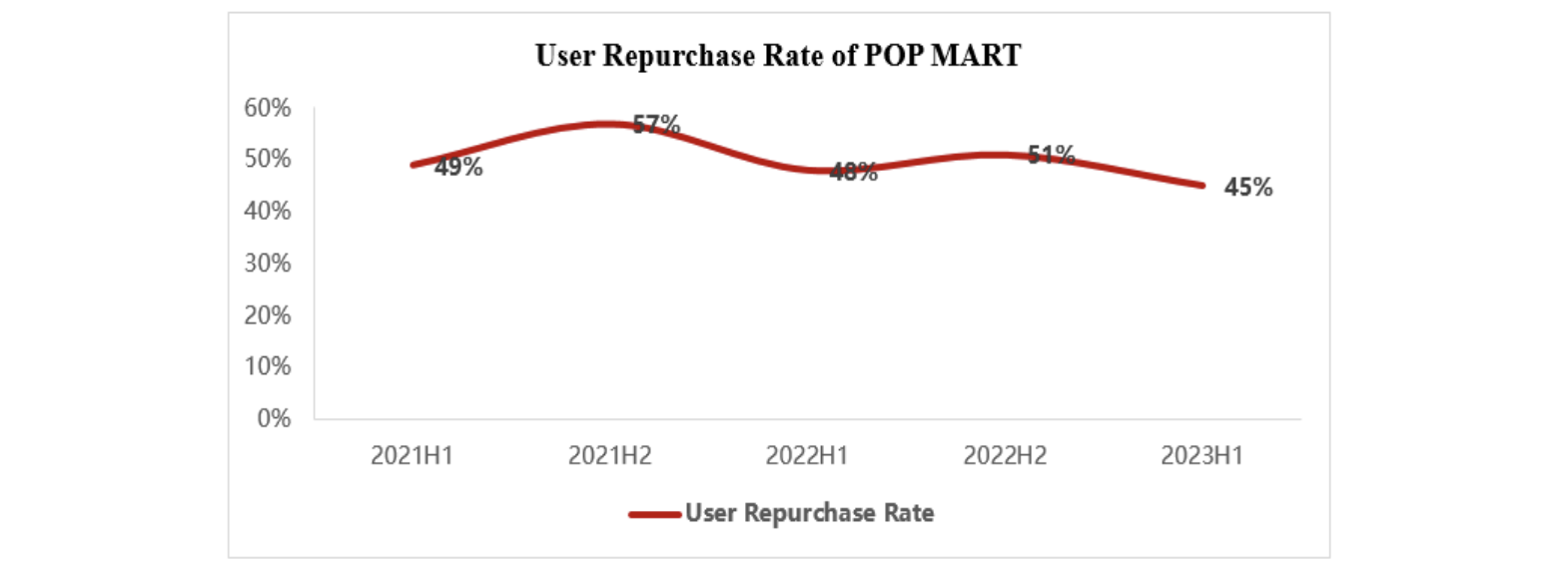
Figure 3: Industry Giant Pop Mart’s User Repurchase Rate
B. Present bias
Present bias may also encourage repeat purchasing, where individuals disproportionately overvalue immediate utility relative to future costs. Before entering a store, a consumer may intend to buy only one blind-box, worth on average between $15 and $45. After opening an undesired or duplicate figure, however, the immediate disappointment can outweigh concerns about future spending, leading to another purchase that was not originally planned. This behaviour is consistent with quasi-hyperbolic discounting, where immediate gratification is outweighed relative to future costs.
C. Sunk cost fallacy
Consumer behaviour of repeat purchasing is largely reinforced by the sunk cost fallacy. After spending substantial amounts of money, attempting to obtain a rare figure, consumers may continue purchasing because abandoning the search would make previous expenditure feel ‘wasted’. Near-miss experiences can further strengthen this effect by creating the perception that obtaining the desired collectible is becoming more likely, even though each purchase remains statistically independent. Receiving a common item is then perceived not as a financial loss, but as a near-miss that mathematically ‘insulates’ the next purchase, convincing the buyer that the desired or rare pull is imminent (Mi, 2023).
An Alternative Perspective
Despite these similarities, blind boxes are not necessarily equivalent to gambling. Unlike traditional channels of gambling, each purchase guarantees a tangible item, meaning consumers may derive genuine utility from collecting rather than uncertainty alone. Many consumers also purchase occasionally, suggesting that repeated purchasing behaviour may reflect personal preferences or recreational collecting rather than behavioural biases. Consequently, the presence of uncertainty does not, by itself, justify gambling-style regulation.
From a welfare perspective, blind boxes may also generate substantial consumer surplus. Many collectors knowingly purchase these items because they enjoy the excitement of uncertainty or value completing collections. If consumers are well-informed and able to internalise the risks, intervention could reduce welfare by limiting the selection of products that many individuals genuinely value.
The relevant economic question is therefore not whether blind boxes resemble gambling, but whether they generate comparable market failures and welfare losses on broader society.
What Evidence Do We Still Need?
Current research establishes a strong positive correlation between digital loot boxes and problem gambling, although most studies rely on cross-sectional surveys and therefore cannot adequately establish causality (Kim et al., 2023). However, very limited evidence is known about physical blind boxes, despite their rapid growth in popularity. It remains unclear whether exposure to uncertainty-based products increases later gambling participation, or whether individuals already predisposed to gambling are simply more likely to engage with them (Greer, Boyle and Jenkinson, 2022).
Future research should be directed at geographic variation in Pop Mart store openings or online platform availability to estimate whether greater exposure to blind-box products affects subsequent gambling participation or financial risk-taking among young Australians. Difference-in-differences or event-study designs would provide substantially stronger causal evidence than the cross-sectional surveys that currently dominate the literature.
Conclusion
Blind boxes illustrate how modern consumer markets increasingly monetise uncertainty rather than simply selling products. Whether this justifies gambling-style regulation should depend not on legal definitions or face-value similarities, but on evidence of market failure and consumer harm. To allow policymakers to determine whether stronger intervention is required to improve social welfare, particularly among young Australians, it would be imperative to improve probability disclosure, collect better expenditure data and identify causal effects of blind-box consumption.
